
Perspectives

The way we measure workplace success is changing
For years, workplace performance has often been judged by how many people are coming in, how much space is being used and whether the office is running efficiently.
As organisations ask employees to spend more time in the office again, those measures still matter, but they don’t tell the whole story.
Our Friction Economy research, developed with WORKTECH Academy, suggests that organisations are starting to think differently about what a successful workplace actually looks like.
Employee experience, operational responsiveness and workplace satisfaction are all expected to become more important over the next three years, while traditional measures such as space utilisation and cost efficiency are ranking lower on the list.
Put simply, leaders are coming around to the fact that a busy office isn’t automatically a successful one.
Attendance only tells you who showed up
An organisation can hit its attendance targets and still have a workplace that’s difficult to use.
People might be coming into the office, but can they connect to the technology they need?
Can they find the right space for the work they’re doing? Is the temperature comfortable? Are problems fixed quickly when something goes wrong?
These everyday experiences matter, particularly when employees are deciding whether the office feels worth the commute.
Our research found that just 6% of workplace leaders reported no points of friction at all, with noise and distraction, technology failures and slow responses to workplace issues among the most common frustrations.
There’s also a clear gap between what organisations want their workplaces to deliver and what happens in practice. 38% of respondents identified technology and tools as one of the biggest gaps between workplace ambition and reality, followed by facilities and maintenance at 34% and workplace experience at 32%.
Attendance can tell you that someone was there, but it can’t tell you whether the workplace helped them do their best work once they arrived.
"Aesthetics and design details do matter in the workplace, but sometimes what I care about is my ability to close the shades. Sure, a building can look beautiful — but does it work?"
Amanda Muzzarelli, Macro Regional Operations Director Americas
Experience is becoming a performance measure
When workplace leaders were asked which metrics would become most important over the next three years, 46% identified employee experience, 38% operational responsiveness and 36% workplace satisfaction by day and location.
This points to a broader way of looking at workplace performance, where success isn’t just about how efficiently space is used, but how well the workplace supports the people using it.
Within our research, we’re already seeing that change. 36% of organisations currently measure workplace performance through employee experience and satisfaction, while 28% combine experience data with operational data.
The next step is to connect those measures more closely.
If employees are consistently reporting a poor workplace experience, operational data can help explain why. Longer response times, unreliable technology or repeated environmental issues can all help organisations understand what’s going wrong and where improvements are needed.
The things that really matter aren’t always the most visible
Some of the biggest influences on workplace experience are also the things employees barely notice when they’re working well.
Reliable technology, responsive maintenance, comfortable temperatures and easy access might not have the same exciting impact as free breakfasts or long lunches, for example, but people notice immediately when they fail.
The research shows just how important these basics are. 42% of workplace leaders identified technology reliability as one of the biggest drivers of workplace perception, followed by cleanliness and maintenance at 34% and environmental comfort at 28%.
It’s easy to focus investment on visible elements such as design, amenities and hospitality, but those experiences only work when the operational basics underneath them are reliable.
Measuring workplace success needs to reflect the experience employees see and feel, as well as the day-to-day performance that makes that experience possible.
What does this mean for FM?
Facilities Management has an increasingly important role to play in workplaces success. After all, FM connects people, place, technology and operations, helping turn workplace strategy into something that works in practice.
Yet just 1 in 5 organisations involve FM from the earliest stages of workplace strategy. Bringing that operational expertise into the conversation earlier can help organisations make better decisions and identify potential problems before they become part of the everyday employee experience.
As workplace metrics evolve, FM teams are also well placed to understand where friction is building, how quickly issues are being resolved and whether the workplace is delivering what it was designed to.
That means looking beyond purely operational reporting and building a clearer picture of how reliability, responsiveness and employee experience connect.
The aim isn’t to stop measuring attendance or utilisation; it’s to stop treating them as the whole picture.
"When some executives hear "workplace experience", they automatically think about employee amenities — expensive amenities like onsite daycare. But ultimately it's not about amenities - it's about workplace effectiveness."
Amanda Muzzarelli, Macro Regional Operations Director Americas
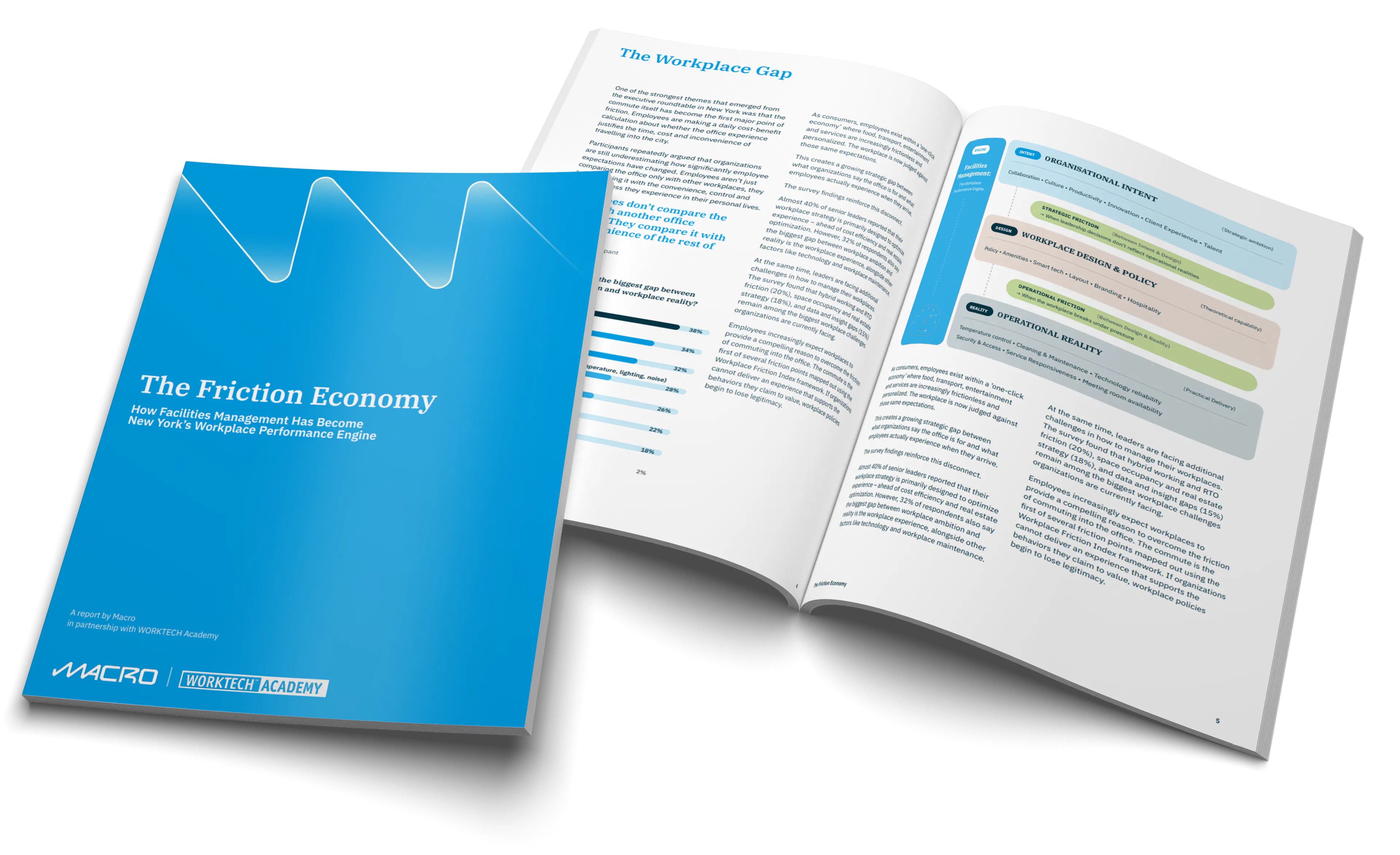
Learn more in the Friction Economy report
The Friction Economy explores how workplace friction is reshaping employee experience,
operational performance and the role of Facilities Management
Download the full reportMore perspectives

Facilities Management: The Missing Link in Sustainability
Sustainability targets are set in the boardroom but delivered in buildings. See how facilities management turns ESG commitments into measurable results.

The Future of Facilities Management - Why Smart Buildings Matter
Discover how smart buildings are transforming facilities management. From IoT and AI to predictive maintenance, sustainability, and workplace wellbeing, learn why intelligent buildings are the future of the built environment.

Internet of Things in Facilities Management - How IoT Transforms FM
How IoT transforms Facilities Management | Macro

How FM Helps UAE Schools Score Higher
How FM Helps UAE Schools Score Higher

What is corporate office facilities management?
A comprehensive overview of corporate office facilities management services and their role in supporting modern organisations

IFMA World Workplace 2026: Macro to Join Key Conversations Shaping the Future of Facilities Management
Macro is proud to be attending IFMA World Workplace 2026, taking place in Anaheim, California, from 18-20 November.