
The Friction Economy Report - Macro x WORKTECH Academy

The Friction Economy Report: How facilities management has become New York's workplace performance engine
New research from Macro and WORKTECH Academy reveals how small operational failures are quietly undermining workplace experience. We explore the role of Facilities Management in bridging the gap between organisational intent and operational reality.
Over the past few years, the workplace conversation in New York has been dominated by return-to-office mandates and debates around attendance. But through the research and conversations that informed this report, it has become clear that attendance is not the real issue organisations are grappling with today. The challenge is the friction between organisational intent and operational reality.
Across New York, organisations are investing heavily in premium workplaces, hospitality-led experiences and smarter buildings in an effort to encourage collaboration, strengthen culture and support performance. Yet many employees continue to encounter environments that feel fragmented, inconsistent and operationally difficult to navigate.
Based on the research insights from 246 workplace leaders across New York. This report explores why that matters, introduces the Workplace Friction Index as a new model for measuring workplace performance, and examines why Facilities Management is becoming one of the most important enablers of organisational effectiveness in New York’s next chapter.
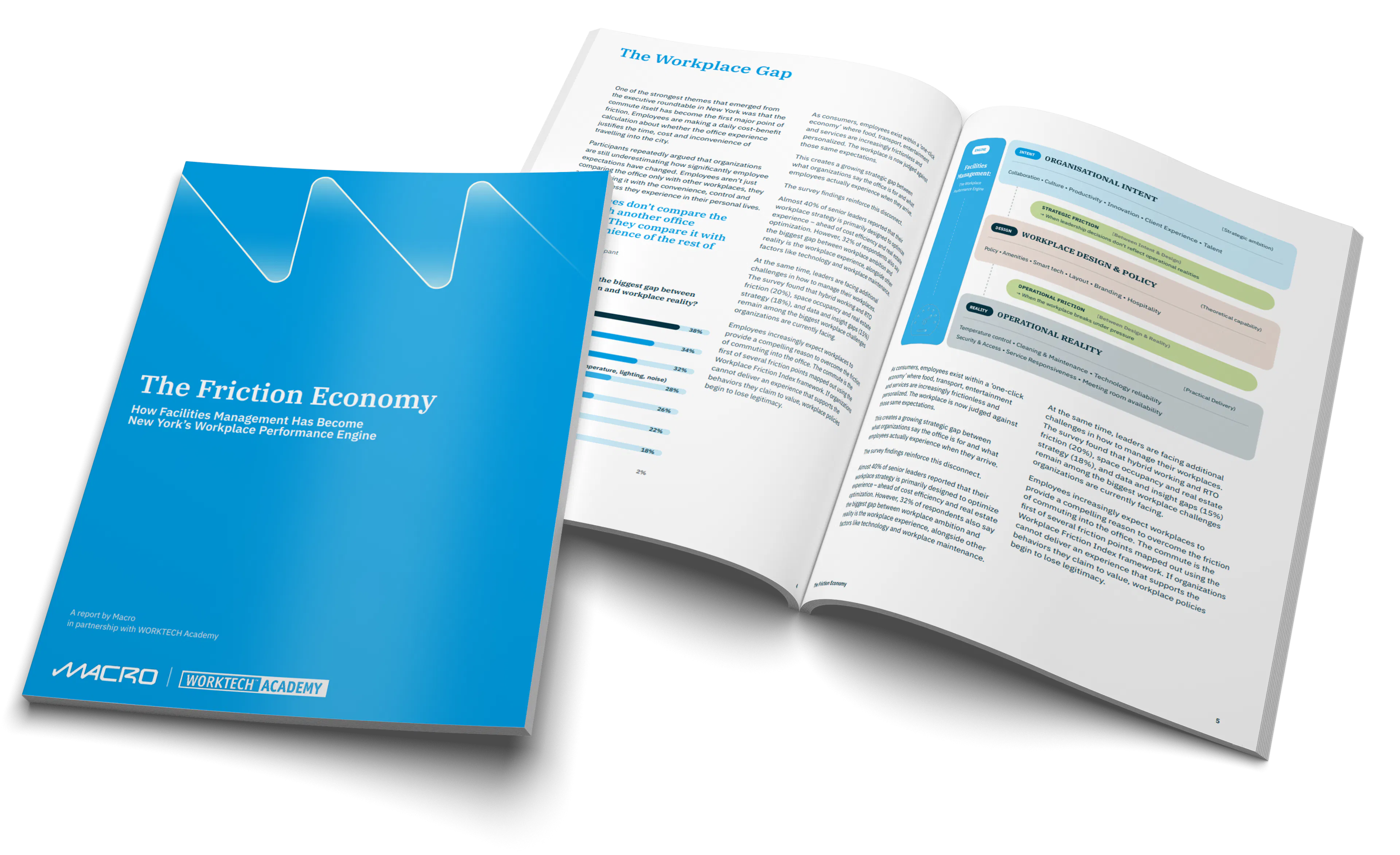
Download the Macro x WORKTECH Academy report
Access the full research report from Macro and WORKTECH Academy, including data, insights and practical frameworks to improve workplace performance; based on research insights from nearly 250 workplace leaders in New York.
Download the reportInside the report
Almost 40% of senior leaders reported that their workplace strategy is primarily designed to optimize experience – ahead of cost efficiency and real estate optimisation. However, 32% of respondents also say the biggest gap between workplace ambition and reality is the workplace experience, alongside other factors like technology and workplace maintenance.
Inside the report
Almost 40% of senior leaders reported that their workplace strategy is primarily designed to optimize experience – ahead of cost efficiency and real estate optimisation. However, 32% of respondents also say the biggest gap between workplace ambition and reality is the workplace experience, alongside other factors like technology and workplace maintenance.
Many organisations invest heavily in what employees can see, design, amenities, events. But the research reveals that the most impactful drivers of performance are often invisible, including:
- Technology reliability
- Environmental comfort
- Cleaning and maintenance
- Service responsiveness
Employees rarely notice when these systems work, but they immediately feel it when they don’t.
Friction isn’t inherently negative. Some forms, like spontaneous interaction or unplanned encounters, create value, collaboration and innovation.
The challenge is distinguishing between:
- Value-creating friction (connection, collaboration)
- Performance-reducing friction (failure, delay, inconsistency)
The most successful organisations are not removing friction entirely, they are managing it intelligently.
Workplace performance is increasingly shaped by the seamlessness of its operations – and with this, Facilities Management becomes a critical infrastructure for organisational performance. Increasingly, FM acts as the connective tissue between organisational ambition and employee experience by orchestrating the systems, services, and environments that determine whether the workplace actually works
Attendance alone is an incomplete indicator of workplace success. Organisations should increasingly measure workplace responsiveness, employee experience, operational reliability and friction reduction through models such as the Workplace Friction Index.
What the research found
Who is the report for
About the research
The Workplace Friction Economy report has been jointly developed by Macro and WORKTECH Academy, based on mixed-method research insights from 246 workplace leaders in New York and an executive roundtable of senior industry decision-makers
Quantitative findings were gathered through a survey of 246 workplace leaders across New York. To deepen these insights, Macro and WORKTECH Academy also convened an executive roundtable in New York with 13 senior workplace leaders from across corporate real estate, facilities management, hospitality and workplace strategy. The report combines survey data with qualitative discussion themes to examine how workplace friction is reshaping the role of Facilities Management.
Download the report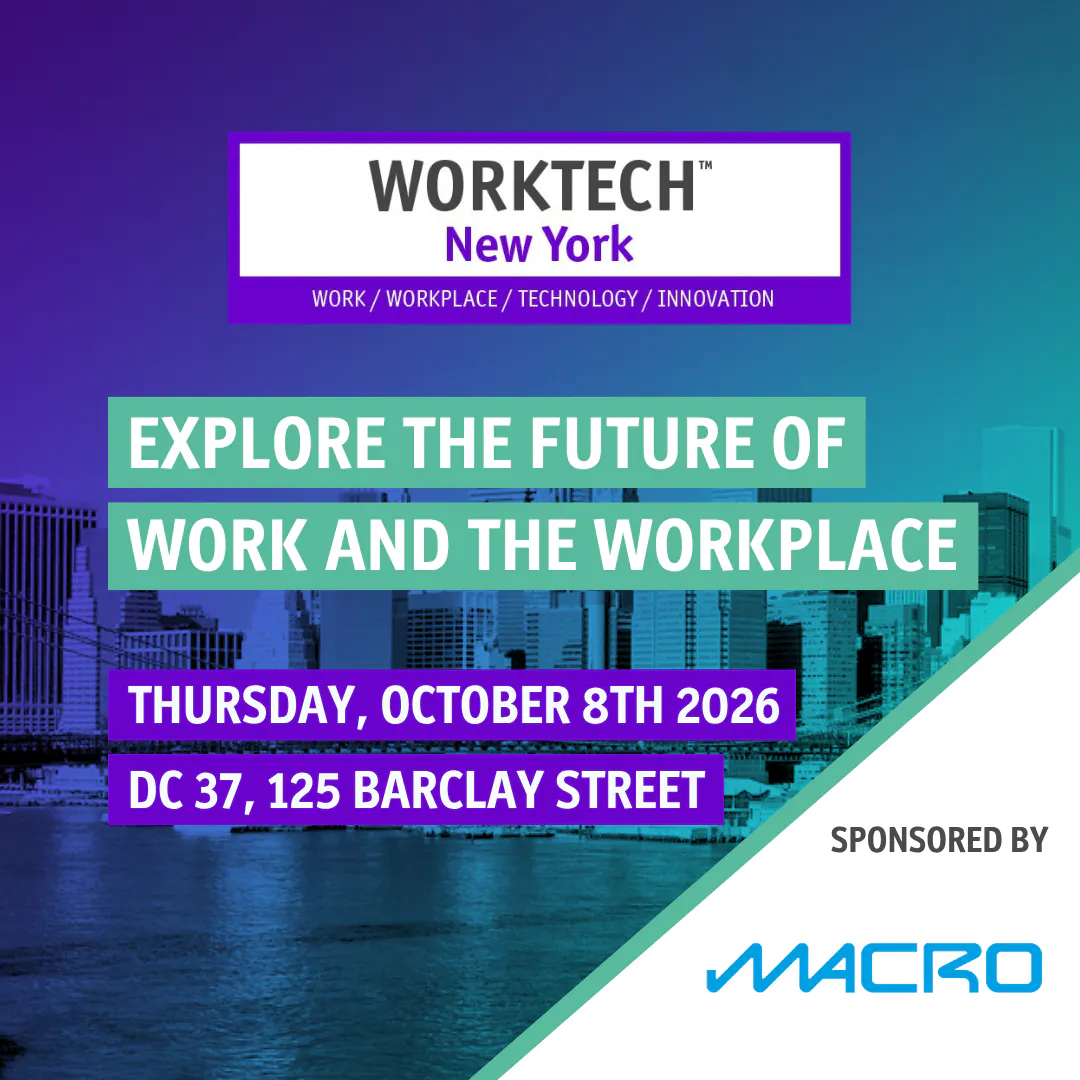
Join us at WORKTECH New York
We’re proud sponsors of WORKTECH New York, taking place at DC 37, 125 Barclay Street, on Thursday October 8th, and we’d love for you to join us.
This full-day conference brings together senior professionals from real estate, workplace, technology, and design to explore the future of work and the workplace.
Join the Macro team at the event to explore how we can support you in delivering exceptional workplace experience.