
Perspectives

Managing Facilities across Global Portfolios: From Operational Complexity to Strategic Advantage
The evolving role of facilities management in supporting global enterprise
As organisations expand across borders, facilities management (FM) is emerging as one of the most complex, and strategically critical, functions with the enterprise.
What was once considered a largely local, operational discipline has evolved into a global business priority. Today’s FM leaders are expected to deliver consistent workplace experiences across regions, navigate varied regulatory landscapes, manage increasingly complex supplier ecosystems, and support organisational performance at scale.
At the same time, expectations have fundamentally shifted. FM is no longer measured solely by efficiency or cost control. It now plays a central role in shaping employee experience, enabling productivity, advancing sustainability goals, and reinforcing brand perception.
This creates a pivotal challenge: how can organisations maintain global consistency while preserving the flexibility needed to operate effectively in diverse local markets?
Consistency at scale
The pressures facing FM leaders are widely understood. What is less widely recognised is where organisations are struggling most.
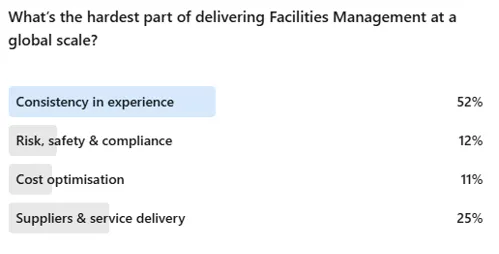
Recent insight from a Macro LinkedIn poll highlights a clear shift in priorities. More than half of respondents (52%) identified consistency of experience across locations as the single biggest challenge in managing FM at global scale. Supplier and service delivery complexity followed at 25%, while risk and compliance (12%) and cost optimisation (11%) ranked significantly lower - highlighting cost is not the primary driver, experience is the bigger challenge.
For years, FM strategies have been anchored on cost efficiency. The data now suggests something different: the central challenge is not cost, the ability to deliver a consistent, high-quality experience across a fragmented global portfolio.
This challenge sits at the intersection of people, processes, suppliers, and systems, and it is where many global operating models begin to break down.
The Reality: Challenges of Managing FM Across Regions
Managing FM across a global portfolio is inherently complex. While each organisation’s footprint is unique, the challenges are consistent and growing.
1. Regulatory and Cultural Complexity
Operating across borders means navigating a patchwork of regulations, compliance standards, and cultural expectations. Ensuring compliance while maintaining efficiency requires both global oversight and deep local expertise.
A global financial services client recently faced this challenge across its multi-country footprint. With varying compliance requirements and inconsistent supplier practices, maintaining oversight became increasingly difficult. By introducing a centralised governance model supported by local expertise, the organisation strengthened compliance while simplifying oversight, highlighting the importance of balancing global control with local knowledge.
Notably, regulatory and compliance challenges were identified by 12% of poll respondents, reinforcing that while critical, they are often overshadowed by broader operational complexity.
2. Consistency vs. Local Flexibility
One of the biggest challenges for global FM leaders is balancing consistency with adaptability.
Macro’s poll revealed 52% of respondents identified consistency in experience as the biggest challenge in global FM delivery, by far the most significant issue facing organisations today.
For many organisations, fragmented service delivery is the result of regional autonomy. In principle, a decentralised approach brings local responsiveness. In practice, however, systems develop independently across regions, supplier networks expand organically and become increasingly difficult to coordinate. Workplace experiences vary widely from one location to another. And leadership teams struggle to maintain a clear, consistent view across their portfolios.
This gap between ambition and execution is more than a structural challenge — it is the underlying cause of many of the issues identified in the data, particularly the difficulty of delivering consistency at scale.
By implementing an integrated global FM model, organisations are able to standardise service delivery, consolidate suppliers, and introduce consistent performance reporting—creating a more unified experience across its global portfolio without losing regional flexibility.
3. Cost Optimisation Without Compromise
Cost remains important but the conversation has shifted from savings to value.
Only 11% of organisations cite cost as the primary challenge, highlighting that leaders are increasingly focused on delivering quality, consistency, and experience rather than simply reducing spend.
A global media organisation facing cost pressures looked beyond traditional cost-cutting measures. By rationalising its supplier base and introducing data-led benchmarking, it reduced duplication and improved accountability across regions.
The outcome was a more efficient operating model, achieved without compromising workplace experience, demonstrating that cost optimisation and quality can coexist when supported by the right structure and insight.
4. Evolving Workplace Expectations
FM has expanded far beyond asset maintenance. Today, it plays a critical role in shaping environments that support collaboration, wellbeing, and productivity.
For a global technology company, delivering consistent workplace experience across locations was a strategic priority. However, aligning service delivery with brand and culture at scale proved challenging.
By introducing dedicated workplace experience teams supported by an integrated FM model, the organisation created a consistent front-of-house experience, improved employee engagement, and strengthened the connection between workplace and organisational culture.
Given that consistency is the leading challenge identified in the poll, these types of experience-led interventions are becoming increasingly critical to success at scale.
5. Expanding Scope, Limited Bandwidth
As portfolios grow, so does the scope of FM. Internal teams are often stretched between operational delivery and strategic initiatives such as sustainability and workplace transformation. Balancing global expansion plans with limited internal resources and complex supplier ecosystems is no easy task.
This challenge is further compounded by supplier complexity—highlighted by 25% of respondents in the poll citing suppliers and service delivery as a key issue, second only to consistency.
By shifting operational delivery to an external partner, organisations can unlock internal capacity - enabling teams to focus on ESG goals, workplace strategy, and long-term planning.
Rethinking the Operating Model
As global organisations continue to grow and diversify, portfolio management can no longer rely on disconnected tools or manual consolidation. The cost of fragmentation — slower decisions, missed opportunities, and reduced return on investment — is simply too high.
To succeed at scale, organisations must rethink how FM is delivered. Organisations need operating models that provide control without complexity and flexibility without fragmentation.
The most effective models combine:
- Centralised governance with local agility
- Standardised processes with regional flexibility
- Data-driven insight enabled by technology
- Simplified and accountable supplier ecosystems
- Embracing technology to drive insight, transparency and performance management
In fact, the poll data clearly reinforces this need: with consistency (52%) and supplier complexity (25%) together accounting for the majority of challenges, organisations must build models that reduce fragmentation while retaining flexibility.
From Cost Control to Strategic Enablement: The Role of Outsourcing
This evolution in operating models is also reshaping the role of outsourcing within FM. Where outsourcing was once viewed primarily as a cost-saving mechanism, it is now increasingly seen as a strategic enabler.
In house-management offers valuable organisational knowledge, greater direct control and oversight of day-to-day operations. Internal teams develop deep knowledge of specific buildings and organisational culture. However, scaling this knowledge across a complex, multi-regional portfolio is inherently challenging.
External partners, by contrast, bring the frameworks, specialist expertise, and scalability needed to deliver consistently across regions. When integrated effectively, they can reduce operational complexity, improve service delivery, and free internal teams to focus on higher-value activities – expansion, ESG initiatives and workplace experience planning.
The most effective organisations are embracing a hybrid approach - retaining strategic oversight in-house while entrusting operational delivery to expert partners.
This model directly addresses the challenges highlighted in the poll, reducing supplier complexity, improving consistency, while unlocking internal capability for strategic initiatives.
The Power of Integrated FM
Integrated FM models are particularly well-suited to global portfolios, providing a single framework for governance, delivery, and performance management.
By bringing governance, delivery, and performance management together within a single framework, organisations can create a stronger connection between central objectives and local outcomes.
A hub-and-spoke approach enables this balance. Central teams provide oversight, standards and strategic direction, while in-country teams deliver services tailored to local needs and conditions.
In practice, this means:
- A shared global portfolio view, with regional and local drill‑down
- Common standards for governance, prioritisation, and reporting
- Local ownership of delivery that respects cultural nuance and market conditions
- Transparent connections between strategy, investment, and execution
This creates a consistent global workplace experience — not by forcing rigid uniformity, but by establishing shared standards, transparency and accountability.
The result is a more resilient, scalable operating model; one that is better equipped to deliver consistent outcomes across diverse markets.
Macro delivers this approach at scale for many of its clients, operating across 45+ countries with centralised management teams supported by local expertise. This ensures consistency in quality, compliance, and reporting - while maintaining the flexibility required to succeed in diverse markets.
Looking Ahead: The Future of Global FM
The FM landscape will continue to evolve. AI, predictive maintenance, advances in technology, rising employee expectations, and continued global expansion will add further complexity to already challenging operating environments.
At the same time, the issues highlighted in the Macro poll, particularly consistency and supplier management, are likely to become even more pronounced as portfolios grow.
Organisations that invest now in the right operating models, technologies, and partnerships will be better positioned to manage this complexity. The organisations that succeed will be those that recognise FM as a strategic capability and invest in operating models designed for scale, simplifying service delivery, and creating stronger connections between global strategy and local execution.
In doing so, they are addressing the industry’s most pressing challenge, consistency, and transforming it into a source of competitive advantage.
The future of facilities management is not just about maintaining buildings. It is about enabling organisations to perform, grow, and succeed, globally.y.
Key Insights at a Glance
Consistency is now the biggest global FM challenge. More than half (52%) of respondents in Macro's poll identified delivering a consistent workplace and service experience across locations as their greatest challenge, ahead of cost, compliance, and risk.
Global success requires balancing standardisation with local flexibility. The most effective FM operating models combine central governance, common standards, and performance reporting with local expertise that can respond to regional regulations, cultures, and business needs
FM has evolved from a cost-control function into a strategic business enabler. Today's FM leaders are expected to support employee experience, productivity, sustainability goals, brand perception, and organisational performance, not just operational efficiency.
Supplier complexity can limit performance at scale. A fragmented supplier network creates inconsistency, inefficiency, and reduced visibility across portfolios. Simplified supplier ecosystems and integrated service delivery models help improve accountability, control, and outcomes.
Integrated FM models provide the foundation for global portfolio success. Organisations that combine central oversight, local delivery, data-driven decision-making, and strategic outsourcing are better positioned to deliver consistent experiences, unlock efficiencies, and support future growth.
Ready to improve how your facilities perform?
Talk to our FM experts about your facility challenges and opportunities. Whether you're managing a multi-site estate, navigating compliance across regions, or simply spending too much on reactive maintenance, we're here to support
More perspectives

New opportunities for Facilities Management highlighted in The Friction Economy Report
Macro x WORKTECH Academy - The Friction Economy: how facilities management has become New York's workplace performance engine
Why Great FM Strategies Fail During Execution: Amanda Muzzarelli Joins IFMA's Connected FM Podcast
Macro's Amanda Muzzarelli joins IFMA's Connected FM podcast to discuss institutional knowledge, psychological safety and leading FM teams through execution.

Bringing brands to life: What makes a store feel like the brand? Patricia Soria & Lisa Holmes explain
Explore how facilities management helps retailers deliver consistent brand experiences, improve operational performance and support customer experience across complex retail estates.

From Reactive to Predictive: The Evolution of Smart Facilities Management
Facilities management isn’t being disrupted by new technology, it’s evolving through the better use of technology that already exists.

PPN026: A Macro Perspective on the UK's Revised Social Value Model
Macro explores the impact of PPN026, the latest update to the UK Government's Social Value Model. Effective from January 2027.

Selecting a Global FM Partner: A quick guide for Commercial Real Estate Leaders
Evaluate facilities management providers with confidence. Explore seven essential criteria covering service integration, sustainability, technology and workplace experience.