
Perspectives
The Friction Economy: Why Facilities Management is New York's Workplace Performance Engine
By Anthony Marroney, Regional Director of Operations, Americas
Ask a senior leader at any major New York financial institution what their workplace priorities are in 2026, and you'll hear familiar answers: drive in-office attendance, strengthen culture, improve collaboration, unlock productivity. The intent is clear. The execution, however, is where things get complicated.
The gap between what an organization intends its workplace to deliver and what employees actually experience is what we, at Macro, have come to call “workplace friction.” And in financial services, where operational precision is everything, it's one of the most underexamined drags on performance in the industry today.
What does friction look like in practice?
Workplace friction rarely announces itself. It accumulates in the details. It's the desk booking system that technically functions, but is so unintuitive most people don't bother with it. It's the floor redesigned for agile working where the cleaning schedule, catering provision, and IT support are still configured for an assigned-seating model. It's the utilisation data that tells you a space is underused, but can't tell you whether that's because it doesn't suit the way people work, because it's consistently too cold, there’s a queue for the toilets, because the ambient sound isn’t conducive to focused or desk-based meetings, or because the AV never works as intended.
Each of these frictions, in isolation, is a minor inconvenience. Together, they become a significant drag on performance and a quiet argument against coming into the office. In 2026, when financial institutions have invested heavily in their offices with the bald expectation that staff turn up to work, these issues aren’t part of the tired “return to office” dialogue but a critical component of a workplace suited to the people that use it daily.
Facilities management is the missing link
The conversation about workplace performance in financial services has, for several years, been dominated by real estate strategy, design, and technology. These are all critical. But the connective tissue is facilities management (FM). It’s the operational layer that turns a well-designed, expensively fitted-out space into a workplace that actually delivers the intended environment.
FM professionals are uniquely positioned to understand friction, because they are closest to it. They hear about it from users daily. They track it through data. They feel it in the volume and nature of service requests. And increasingly, the most forward-thinking FM teams are using that intelligence not just to react, but to shape workplace strategy from the ground up.
The companies I've seen get this right tend to share a few characteristics. They treat FM as a strategic partner in workplace decisions, not a delivery function at the end of a procurement chain or a cost center draining the bottom line. The companies that get it share data across real estate, FM, IT and HR in ways that allow operational patterns to inform design and policy. And they invest in a service model that is genuinely aligned with how their people work today.
I was speaking to a former HR colleague who recently took a new role at a bank that has combined People and Places. We discussed how much the corporate environment has changed for HR and real estate in the last five years. We used to sit in separate verticals that didn’t share data. HR corporate plans were done in isolation of the real estate team who would need to ensure sufficient space and infrastructure for those employees. IT had its own investment and CapEx plans completely disassociated from real estate CapEx cycles and people strategy changes.
Now, HR, technology, and real estate need to be hyper-connected for organizations to strategically ensure productivity and optimal investment management. You can’t have mandates for higher office attendance without space and technology to ensure people can do their jobs effectively in the office. Just over five years ago, we met in person without digital meeting platforms, but now we almost always have hybrid meetings even when most people are in the office because companies are global and we have the technology to be more connected. The world seems to grow smaller and the corporate environment less siloed, but all of the strategic outputs fall over if you don’t have a facilities team who brings the workplace strategy and experience to life.
What comes next
Workplace friction is the conversation I'll be bringing to Financial Workplace New York 26 on the 15th of April. I'll be hosting a session called: 'The Friction Economy: How Facilities Management is New York's Workplace Performance Engine' at Mastercard's NYC Tech Hub.
The session will also offer the first glimpse into a research report Macro is producing in partnership with WORKTECH, publishing in June 2026. The report draws on insight from workplace and FM leaders across the financial sector to map where friction exists, identify what the highest-performing organisations are doing about it, and make the case for FM as a strategic priority.
If you'll be at the event, I'd love to connect.
Event details
Financial Workplace New York 26, Wednesday 15 April 2026, Mastercard NYC Tech Hub, 150 5th Avenue, New York City.
More on Macro’s role at the conference.
More perspectives
Why Great FM Strategies Fail During Execution: Amanda Muzzarelli Joins IFMA's Connected FM Podcast
Macro's Amanda Muzzarelli joins IFMA's Connected FM podcast to discuss institutional knowledge, psychological safety and leading FM teams through execution.
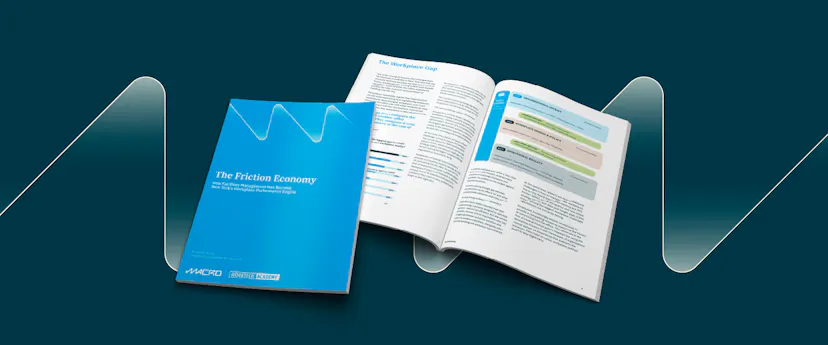
New opportunities for Facilities Management highlighted in The Friction Economy Report
Macro x WORKTECH Academy - The Friction Economy: how facilities management has become New York's workplace performance engine

Inside Macro’s Smart Building Solution - How We Deliver Intelligent FM
Discover Macro’s Smart Building Platform – combining IoT, AI, and digital twin technology to deliver predictive maintenance, energy efficiency, and people-focused spaces. Scalable, secure, and data-driven, our solution transforms facilities management with real-time insights, sustainability gains, and smarter operations.

Bringing brands to life: What makes a store feel like the brand? Patricia Soria & Lisa Holmes explain
Explore how facilities management helps retailers deliver consistent brand experiences, improve operational performance and support customer experience across complex retail estates.
From Reactive to Predictive: The Evolution of Smart Facilities Management
Facilities management isn’t being disrupted by new technology, it’s evolving through the better use of technology that already exists.
Managing Facilities across Global Portfolios: From Operational Complexity to Strategic Advantage
Exploring the evolving role of facilities management in supporting global real estates